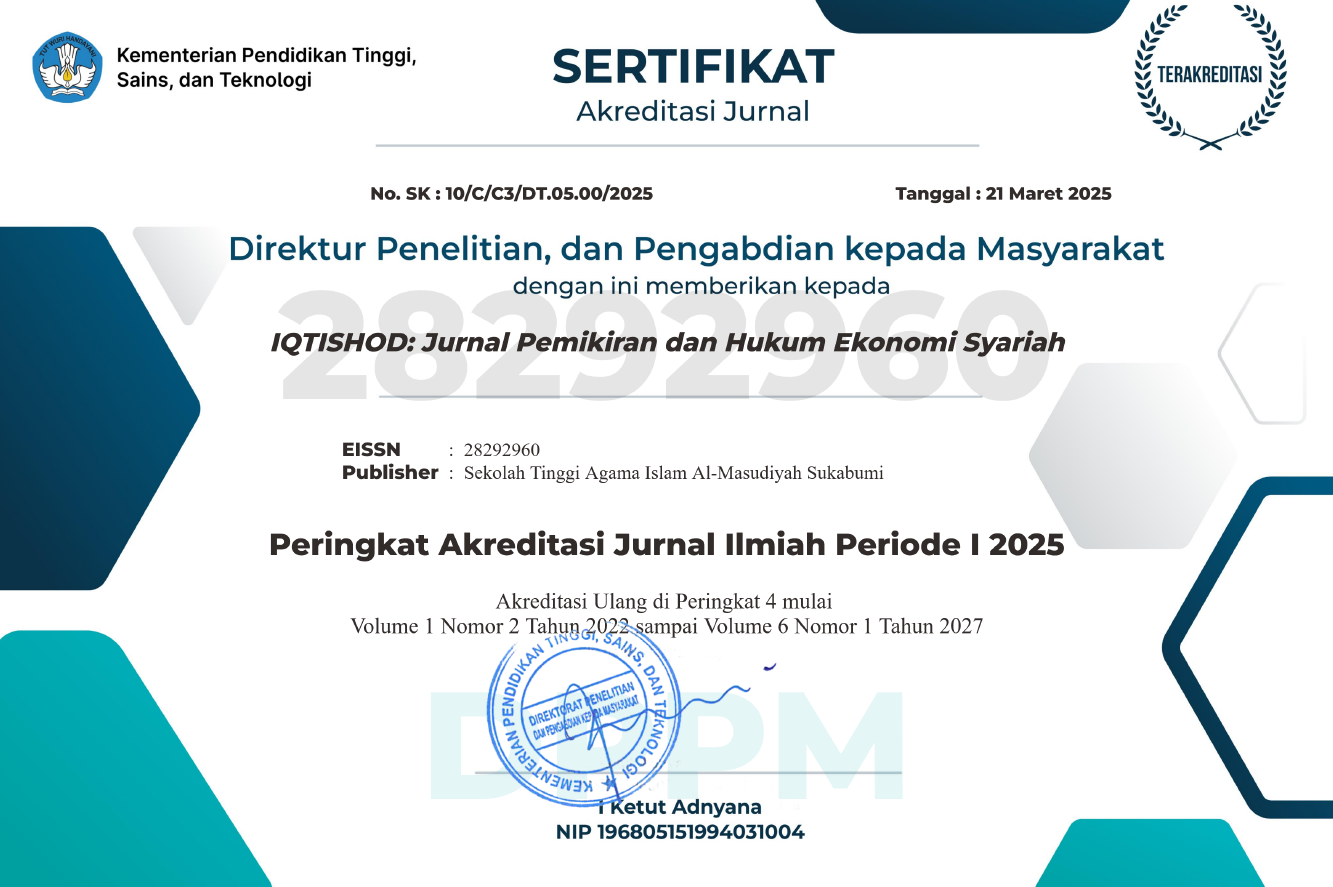
Istishab: Dynamics of Islamic Legal Construction and Its Significance in Digital Era Fiqh Muamalah Transformation
DOI:
https://doi.org/10.69768/ji.v4i2.146Keywords:
Istishab, Legal Construction, Digital Fiqh Muamalah, Islamic Legal MethodologyAbstract
This research aims to investigate the position of istishab in the epistemological hierarchy of Islamic law, explore its operationalization mechanisms in the istinbat process, and analyze its impact on the evolution of contemporary fiqh muamalah. The methodology employed is library research with a descriptive-analytical approach to classical and modern literature on istishab. Research findings indicate that istishab functions as a mechanism for preserving the legal status quo until evidence is found that changes it. Despite divergent scholarly opinions regarding its legal authority, the majority of scholars from the Malikiyyah, Shafi'iyyah, and Hanabilah schools acknowledge the validity of istishab as a legal proof. In the context of digital-era fiqh muamalah, istishab makes significant contributions to Islamic financial product innovation, digital economic regulation formulation, and business conflict resolution. The maxims al-yaqin la yuzalu bi al-syak (certainty is not removed by doubt) and al-ashl fi al-asyya' al-ibahah (the original state of things is permissibility) serve as the foundation for implementing istishab in contemporary muamalah innovations. In conclusion, istishab has high relevance as an instrument for Islamic law adaptation to civilizational dynamics, particularly in the muamalah domain experiencing accelerative transformation.
Downloads
References
Ahmed, H., Khan, M. F., & Hassan, M. K. (2022). Blockchain technology and Islamic finance: Opportunities and challenges. Journal of Islamic Banking and Finance, 39(3), 245–267.
Ahmed, S., & Ismail, A. G. (2022). Digital Islamic finance and sustainable development: A maqasid perspective. International Journal of Islamic and Middle Eastern Finance and Management, 15(4), 678–695.
Al-Maqdisi, Y. (2020). Contemporary methodology in Islamic jurisprudence: Challenges and opportunities. Cambridge University Press.
Al-Maqdisi, Y., & Hassan, M. K. (2023). Artificial intelligence and Islamic finance: Regulatory perspectives. Islamic Economic Studies, 31(1), 45–62.
Bakar, M. D. (2023). Decentralized autonomous organizations from Islamic perspective: Governance and compliance issues. Journal of Islamic Finance, 12(2), 134–149.
Bakar, M. D., & Hassan, R. (2023). Islamic robo-advisors: Shariah compliance and regulatory framework. ISRA International Journal of Islamic Finance, 15(3), 287–304.
Hallaq, W. B. (2020). Restating orientalism: A critique of modern knowledge. Columbia University Press.
Hassan, M. K. (2022). Blockchain technology in Islamic finance: Theoretical foundations and practical applications. Qualitative Research in Financial Markets, 14(4), 523–541.
Hassan, M. K. (2023). Quantum computing and Islamic cryptography: Future implications for Islamic finance. Technology and Investment, 14(3), 178–195.
Hassan, M. K., & Khan, A. (2023). Central bank digital currencies from Islamic perspective: Opportunities and challenges. International Journal of Emerging Markets, 18(7), 1456–1473.
Hassan, M. K., & Mahlknecht, M. (2022). Islamic capital markets: Products, regulation and development. Edward Elgar Publishing.
Ismail, A. G. (2022). Islamic banking and finance: Theory, concepts and practice. Pearson Malaysia.
Ismail, A. G., & Ahmed, H. (2023). Smart contracts in Islamic finance: Legal and Shariah perspectives. Arab Law Quarterly, 37(2), 189–212.
Ismail, A. G., & Hassan, M. K. (2022). Digital transformation in Islamic banking: Innovation and compliance. International Journal of Bank Marketing, 40(6), 1247–1268.
Khan, A., Ahmed, H., & Hassan, M. K. (2023). Regulatory frameworks for Islamic fintech: A comparative analysis. Journal of Financial Regulation and Compliance, 31(3), 412–428.
Khan, T., & Ahmed, H. (2023). Digital Islamic finance: Innovation within regulatory boundaries. Thunderbird International Business Review, 65(4), 445–461.
Ramadan, I. M. (2021). Istishab in Islamic jurisprudence: Theory and application. Dar Al-Fikr.
Ramadan, I. M. (2023). Smart contracts and Islamic law: Compatibility and implementation challenges. Computer Law & Security Review, 48, 105789.
Ramadan, I. M., & Al-Maqdisi, Y. (2022). Regulatory sandbox for Islamic fintech: Balancing innovation and compliance. Law and Financial Markets Review, 16(3), 234–249.
Ratnasari, A. R., & Fadhil, F. (2025). Peran Fatwa dalam Menyusun Qanun : Tinjauan Fiqh dan Implikasinya dalam Praktik Hukum. 4(1), 151–163. https://doi.org/10.69768/ji.v4i1.81
Zysow, A. (2019). The economy of certainty: An introduction to the typology of Islamic legal theory. Lockwood Press.
Downloads
Published
How to Cite
Issue
Section
License
Copyright (c) 2025 Ahmad Yusdi Ghazali, Siti Nuraeni, Agung Hari Wibowo, Amalia Amalia

This work is licensed under a Creative Commons Attribution-ShareAlike 4.0 International License.